
The practical, end-to-end online course that teaches you how RL is used to fine-tune LLMs, through clear explanations and hands-on labs.
Enter your name and email below to join our waitlist and the first to know when we open admission for our next course.
by signing up you will receive valuable information from The RAG Pack. You can unsubscribe anytime.
Join us to learn how to:
-
Explain the full LLM training stack and where RL fits
-
Choose between PPO/DPO/GRPO/GSPO for real use cases
-
Design reward signals (including verifiable rewards)
-
Build a simple tool-using agent and fine-tune it with RL
-
Debug RL fine-tuning with practical diagnostics

Who is this course for?
-
ML / LLM engineers and applied scientists who want practical RL-for-LLMs skills
-
Data scientists who can code but want to understand and implement RLHF-style training
-
Builders working on agents, tool use, reasoning, or reliability improvements
-
You should be comfortable with: Python + basic deep learning concepts.
Program Overview
Live virtual sessions
Learn directly from five well-known instructors who teach clearly and build things that work.
Access to labs
and a learning platform resources available for you to learn on your own schedule
Community
You won’t be learning alone. Expect structured support and a place to ask questions as you go.
You’ll also get access to:
- Step-by-step coding labs (including an agent you’ll build and improve)
- Templates, notebooks, and reference implementations
- Recommended readings + “cheat sheets” for key methods
- Replays (so you can review anything you missed)

Course curriculum
Module 1: The Essential Concepts of Reinforcement Learning
with Josh Starmer
A clean foundation: environments, rewards, policies, and how RL differs from supervised learning. You’ll see RL in action and code a simple example to make optimal decisions under uncertainty.
Module 2: The Evolution of RL for LLMs: RLHF → Verifiable Rewards
with Maarten Grootendorst
Understand common reinforcement learning algorithms, like PPO and GRPO, along with several use cases such as reasoning, tool use, and test-time reinforcement learning.
Module 3: GRPO Deep Dive
with Luis Serrano
A focused, intuitive deep dive into GRPO—what’s happening under the hood, why it works well for verifiable rewards, and what tradeoffs to watch.
Module 4: Labs 1–2: Setting up the Calculator Agent
with Chris McCormick
You’ll build the full scaffold: prompts, tool interface, evaluation loop, and a reward signal that can be verified.
Module 5: Lab 3: Dissecting a GRPO training run
with Jay Alammar
Put it all together: an in-depth look at a full RL training run, the systems involved, and what changes across the training run.
BONUS Module: Join us for an "Ask Us Anything"
Whether you have additional technical or career questions, the full team will be available for you.
Faculty

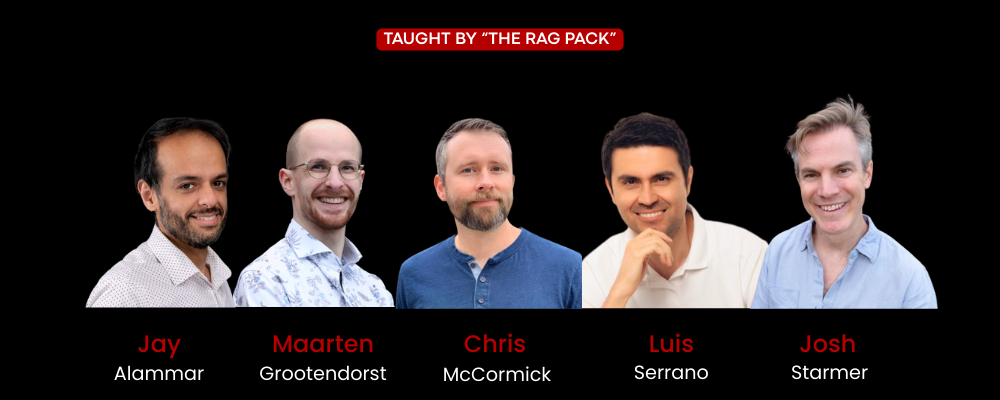
Jay Alammar is a machine learning researcher and writer, co-author of Hands-On Large Language Models: Language Understanding and Generation, whose illustrated articles have helped millions visually understand transformers and modern NLP.

Maarten Grootendorst is a data scientist and creator of popular NLP libraries like BERTopic and KeyBERT, and co-author of Hands-On Large Language Models: Language Understanding and Generation, bridging cutting-edge research with practical tools.

Chris McCormick is a leading AI educator and researcher whose deep-dive tutorials on BERT, transformers, and NLP have become go-to references for practitioners worldwide, combining rigorous understanding with clear, implementation-ready code.

Luis Serrano is an ex-Google, ex-Apple AI scientist, educator, and author of Grokking Machine Learning, dedicated to making complex ideas intuitive and accessible through the Serrano Academy platform.

Josh Starmer is the founder of StatQuest and author of The StatQuest Illustrated Guide to Machine Learning and The StatQuest Illustrated Guide to Neural Networks and AI, known for turning intimidating concepts into clear, joyful explanations.
At the end of the course you'll receive a certificate of completion