Everyone is talking about AI agents.
But what actually turns an LLM into an agent?
What roles do reasoning, memory, tools, planning, and evaluation play? And how should you think about the growing number of agent frameworks and harnesses?
In this masterclass, you will:
-
Build a clear mental model of what an AI agent actually is—and how it differs from a standard LLM application.
-
See how reasoning, memory, tools, planning, and evaluation fit together to turn an LLM into an agentic system.
-
Develop a framework-independent way to think about agents, so you can better understand the tools and harnesses appearing across the ecosystem.
📅 Sept 29, 2026
⏰ 1:00 pm ET / 10:00 am PT
Register to join us
After signing up you will receive invitations to upcoming programs and helpful resources. You can unsubscribe anytime.
If you can't join live, go ahead and register and we'll send you the recording.
00
DAYS
00
HOURS
00
MINS
00
SECS
What will you learn?
1. What actually makes an AI system an agent?
What can an LLM do on its own? Where does it fall short? What changes when we give it the ability to interact with an environment, maintain state, and decide what to do next?
You’ll learn the difference between a standard LLM application, an LLM workflow, and a genuinely agentic system.
2. Why reasoning matters
An agent needs to work through problems, decide between possible actions, and reason about what should happen next.
We’ll introduce the role of reasoning LLMs and give you intuition for approaches such as Chain-of-Thought, search against verifiers, and other techniques that improve reasoning behavior. These topics sit at the heart of the course’s second lecture.
3. Memory + tools: from talking to doing
A standalone LLM is fundamentally limited. Memory gives an agent useful context across interactions and actions. Tools let it do things outside the model—retrieve information, call APIs, run code, interact with software, and affect its environment.
4. Planning, reflection + autonomy
Once an agent can reason, remember, and use tools, it can begin tackling longer and less predictable tasks.
We’ll introduce how agents break problems into steps, sequence actions, respond to feedback, reflect on results, and adapt their plan along the way.
5. How do you know whether an agent is actually good?
A convincing final answer doesn’t necessarily mean the agent worked correctly.
We’ll introduce the different layers of agent evaluation, from outcomes to the trajectory of decisions and actions, along with reliability and safety.
6. Making sense of agent harnesses
Today’s agent harnesses and frameworks package many of these capabilities together. Once you understand the components underneath them, it becomes much easier to see what a framework is doing for you, and what tradeoffs it introduces.
Who is this masterclass for?
This session is designed for technical people who already use AI and want a clearer understanding of what comes next.
Software engineers moving into agentic AI
You’ve started seeing agents everywhere and want to understand the architecture beneath the APIs and frameworks.
ML / AI engineers
You understand models, but want a more complete mental model of how reasoning, memory, tools, planning, and evaluation come together.
Data scientists and technical ML practitioners
You want to understand where agents fit into modern AI systems and how to reason about them beyond the buzzwords.
AI-curious technical leaders and builders
You need enough understanding of the agent stack to make better technical, product, or architecture decisions.
You’ll get the most out of the session if you already have basic familiarity with AI and LLMs. No previous agent-building experience is required.
Led by five of the most renowned AI educators in the world
(aka, "The RAG pack")
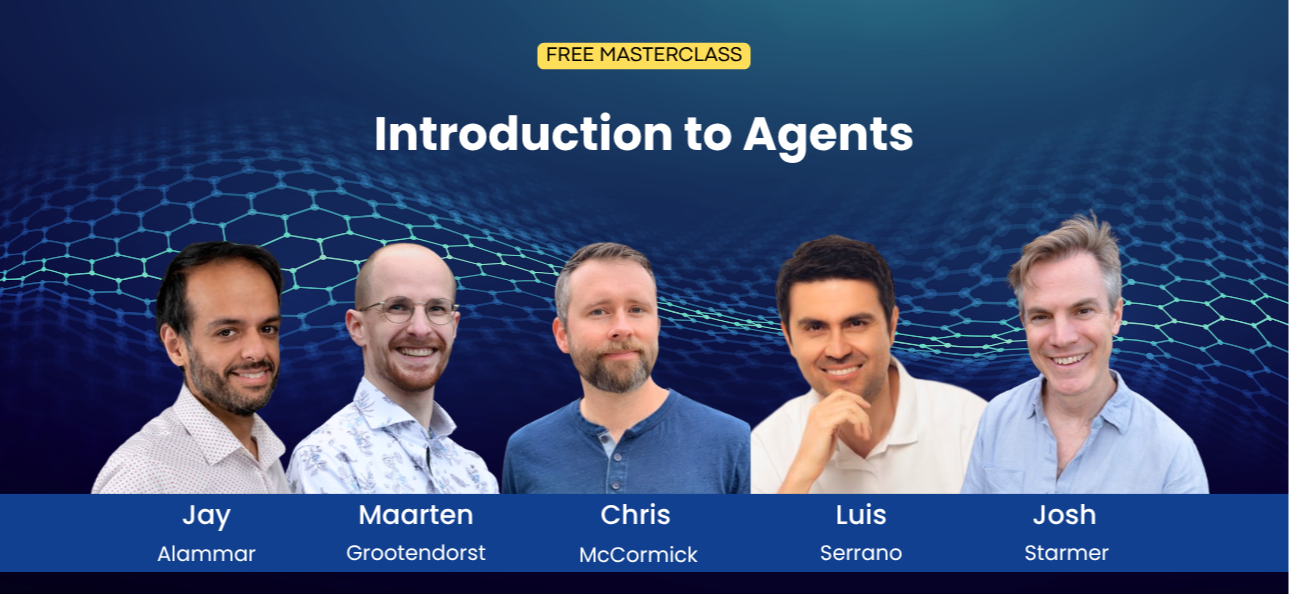
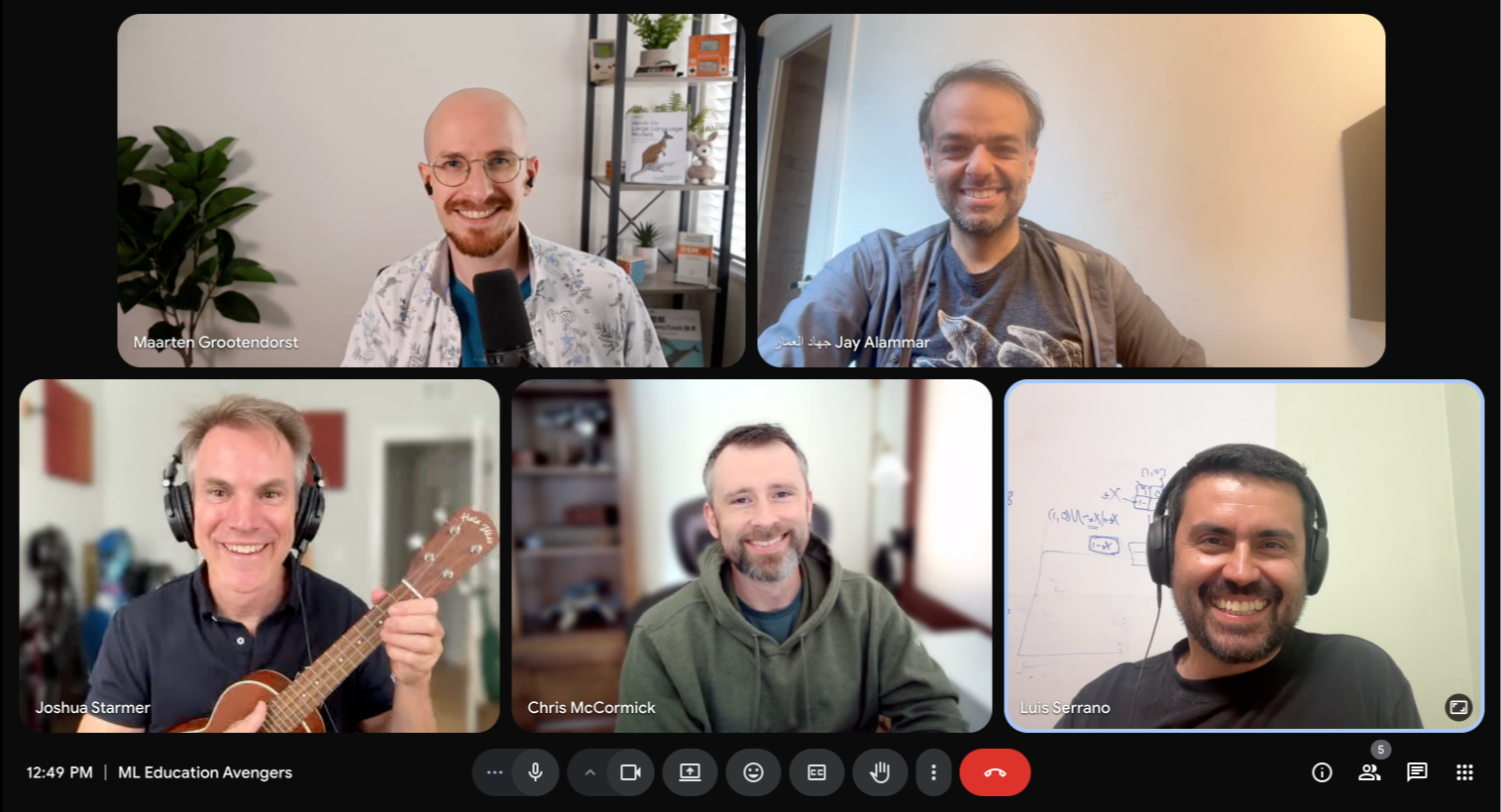
Jay Alammar is a machine learning researcher and writer, co-author of Hands-On Large Language Models: Language Understanding and Generation, whose illustrated articles have helped millions visually understand transformers and modern NLP.

Maarten Grootendorst is a data scientist and creator of popular NLP libraries like BERTopic and KeyBERT, and co-author of Hands-On Large Language Models: Language Understanding and Generation, bridging cutting-edge research with practical tools.

Chris McCormick is a leading AI educator and researcher whose deep-dive tutorials on BERT, transformers, and NLP have become go-to references for practitioners worldwide, combining rigorous understanding with clear, implementation-ready code.

Luis Serrano is an ex-Google, ex-Apple AI scientist, educator, and author of Grokking Machine Learning, dedicated to making complex ideas intuitive and accessible through the Serrano Academy platform.

Josh Starmer is the founder of StatQuest and author of The StatQuest Illustrated Guide to Machine Learning and The StatQuest Illustrated Guide to Neural Networks and AI, known for turning intimidating concepts into clear, joyful explanations.

Don't miss the opportunity to learn from this group, ask your questions, and understand the latest in agentic AI.
Register below
After signing up you will receive invitations to upcoming programs and helpful resources. You can unsubscribe anytime.