What Makes an AI Agent?
Understand what separates an agent from a standard LLM application and the core components that enable autonomous action.
Early Bird Sale: save $250. Ends October 2
Go from using AI to understanding how agents actually work. Across six live, hands-on sessions, you’ll build a working AI agent in Python from the ground up—adding reasoning, memory, tools, planning, and evaluation as you go.
Next Cohort: Oct 14 - 31
Wednesdays + Saturdays • 1 PM ET • 90 minutes per session
Frameworks can make an agent surprisingly easy to assemble. But that doesn’t necessarily tell you why the agent works, what each component is doing, where failures come from, or what to change when something goes wrong. And the framework you learn today may not be the one you’re using next year.
Introduction to Agents takes a different approach. You’ll start with the LLM at the center of an agent and progressively add the capabilities that let it reason, remember, use tools, plan, act, reflect, and be evaluated.
You won’t just learn the concepts. You’ll implement them yourself.

See how reasoning LLMs, memory, tools, planning, and evaluation fit together as one system.
Implement each major component in Python and finish with a working agent.
Build a durable mental model you can apply across today’s agent harnesses—and whatever comes next.
- Yanto, RAG Pack alum
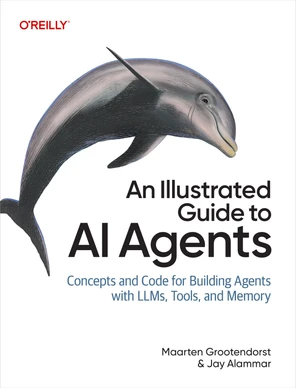
The course follows the Foundations portion of Maarten Grootendorst and Jay Alammar’s O’Reilly book and takes the learning experience further with live teaching, implementation, Q&A, and community.
Understand what separates an agent from a standard LLM application and the core components that enable autonomous action.
Explore LLM architecture, training, and the reasoning techniques that make multi-step agent behavior possible.
Learn memory, retrieval, context engineering, tool definitions, tool calling, and concepts behind MCP.
Learn task decomposition, action sequencing, reflection, and how an agent can revise its plan while working.
Evaluate outcomes, trajectories, reliability, and safety across complete agent systems.
Use your foundation to evaluate modern agent harnesses, understand what they abstract away, and compare tradeoffs.
Learn directly from five well-known instructors who teach clearly and build things that work.Â
The live sessions start on Wednesday October 14th. We will meet on Wednesdays and Saturdays at 1:00pm ET / 10:00am PT, through October 31.Â
and a learning platform resources available for you to learn on your own schedule
You won’t be learning alone. Expect structured support and a place to ask questions as you go.
A PDF copy of An Illustrated Guide to Agents by Jay Alammar and Maarten Grootendorst
Software engineers
You're moving into agentic AI and want to understand what is happening inside the frameworks you’re beginning to use.
ML / AI engineers
You understand models and want a complete picture of reasoning, memory, tools, planning, and evaluation.
Technical data + ML practitioners
You want a rigorous mental model plus enough implementation depth to build and reason about agents yourself.
Â
Starts October 14 · Wednesdays + Saturdays · 1 PM ET
Save $250. Includes the complete program, recordings, Discord access, ebook, and certificate.
Includes the complete program, recordings, Discord access, ebook, and certificate.
Student pricing for active university students. Verification required.
Make the case for training that translates directly into technical work.
Share with your managerCorporate seat licensing is available for engineering, ML, and data teams.
Contact us about team licenses
Jay is a machine learning researcher and writer, co-author of Hands-On Large Language Models: Language Understanding and Generation, whose illustrated articles have helped millions visually understand transformers and modern NLP.
Maarten is a data scientist and creator of popular NLP libraries like BERTopic and KeyBERT, and co-author of Hands-On Large Language Models: Language Understanding and Generation, bridging cutting-edge research with practical tools.
Chris is a leading AI educator and researcher whose deep-dive tutorials on BERT, transformers, and NLP have become go-to references for practitioners worldwide, combining rigorous understanding with clear, implementation-ready code.
Luis is an ex-Google, ex-Apple AI scientist, educator, and author of Grokking Machine Learning, dedicated to making complex ideas intuitive and accessible through the Serrano Academy platform.
Josh is the founder of StatQuest and author of The StatQuest Illustrated Guide to Machine Learning and The StatQuest Illustrated Guide to Neural Networks and AI, known for turning intimidating concepts into clear, joyful explanations.
Feedback from students in previous RAG Pack programs.
“The course is a massive time-saver that distills high-quality, expert-selected resources into a perfectly curated form.
“What really sets it apart is the people—some of the most respected voices in AI are not just teaching but actively engaging with students.
“Where else can we get 5 superstars to present on a topic for us to learn?
Get started today before this once in a lifetime opportunity expires.